Sound Healing

Let the sound do the work

Hand-hammered Himalayan bowls, a gong, and an hour in which you are asked to do nothing at all. Twelve distinct therapies, each with its own purpose and its own pace — so you can choose rather than guess.

What happens

You lie down. That is all

You need no experience, no flexibility and no particular belief. You lie on a mat with a bolster under your knees and a blanket if you want one, and you stay fully clothed throughout.

The practitioner sits beside you with a set of hand-hammered Himalayan bowls, a gong, and smaller instruments — tingsha, a bell. Some bowls are played around the body. In several of the therapies, bowls rest directly on the body, so the vibration travels through you rather than only reaching your ears.

Most of the hour you spend doing nothing at all. That is the work.

In the studio

The twelve

Twelve ways to be played

All sixty minutes · Most also available one to one

01

Energy Purification & Relaxation

Aura Cleansing

Full-body bowl placement, working from the head down. Book this one if you cannot name what is wrong and simply feel heavy, foggy or depleted. It clears that sense of weight and ends in deep, settled rest.

02

Shushumna Activation

Sushumna

Named for the central channel of yogic anatomy, which runs along the spine. Bowls are placed along the spine itself, and the session is quieter and more precise than the others. People finish it with a noticeably steadier breath.

03

Psychic Energy Balancing

Prana

Gentle, non-invasive work on the subtle energy field rather than the physical body. Most often recommended to people whose minds will not stop — the ones who say they cannot meditate because their thoughts are too loud.

04

Sacral Therapy

Svadhisthana

Focused on the sacral centre, low in the abdomen, using the lower-frequency bowls. Low frequencies are felt more than heard. This one tends to release tension people have carried so long they had stopped noticing it.

05

Whole Body Massage

Kaya

Despite the name, this is not a hands-on oil massage. The bowls do the work. They are rested on the body and struck, and the vibration travels from head to feet. It eases muscular tightness without anyone pressing on you — useful if you find conventional massage uncomfortable.

06

Chakra Healing

Chakra

A bowl tuned to each of the seven centres, worked in sequence from crown to root. Of all twelve this is the most structured, and the easiest to follow if you like knowing what comes next.

07

Vedic Therapy

Veda

Rooted in Vedic practice, with mantra used alongside the bowls. Shaped around what you bring on the day rather than following a fixed sequence.

08

Vedic Healing

Yajna

Mantra, sound and intention together, held in a traditional ritual setting. Available individually or for small groups. Where Vedic Therapy adapts to the person, this follows the older ceremonial form.

09

Brainwave Therapy

Nada

Paired bowl frequencies, used to guide the mind from its ordinary alert state toward the slower rhythms associated with deep rest. People book this one for sleep and focus.

10

Brainwave Healing

Nidra

The longer, deeper version of the above — layered frequencies across an extended session. This is the one for genuine mental fatigue, the kind a weekend does not touch.

11

Hot & Cold Water Therapy

Snana

The outlier. A traditional contrast method alternating hot and cold water, used for circulation and recovery. No bowls involved. It belongs to the same therapeutic programme, and people often pair it with a sound session.

12

Group Healing & Sound Bath

Samuha

For groups, teams and friends, minimum four people. You lie back and receive; there is nothing to learn or keep up with. Held at the studio, or we bring the instruments to your venue.

Booking

What a session costs

From USD 25 / NPR 2,500

Sixty minutes, any of the twelve

From USD 10 / NPR 1,000

Per person, minimum four · At the studio or your venue

Tell us which of the twelve you want and we will know what to prepare. If you are not sure, say what you are dealing with — sleep, tension, a mind that will not settle — and we will suggest one. You can also simply come to a group sound bath first and decide afterwards.

Being straight with you

What the research actually says

A 2025 systematic review in Healthcare gathered fourteen quantitative studies of Tibetan singing bowl interventions from the previous sixteen years. It concluded they demonstrate potential for stress reduction and psychological well-being as a non-invasive complementary method, with most studies reporting less anxiety, improved heart rate variability and lower heart rate.

The same review is candid about the weaknesses, and so are we: the certainty of the evidence ranged only from low to moderate, sample sizes were mostly small, the studies varied too much to pool, and few followed anyone up over the longer term.

So there is real published signal, and it points in a consistent direction. That is not the same as proof. Anyone telling you sound healing cures disease is going beyond what the evidence supports. We offer these sessions for rest, for relief from tension, and for a nervous system that has forgotten how to switch off. That is what they are good at.

Systematic review, Healthcare, 2025Goldsby et al., J. Evid. Based Complementary Altern. Med., 2017
Train to teach it

Learn to hold the bowls yourself

Two levels of certification, both internationally recognised. Level I takes a complete beginner to someone who can structure and hold a session. Level II takes that practitioner to professional client work. Schedules are flexible — tell us the dates that suit you.

Level I — Foundation

20 hours · No experience needed · Internationally recognised certificate

Where the instruments come from, how to choose and read a bowl, and the technique to play one safely and well. By the end you can structure and hold a simple session, and you have your own daily practice as a practitioner.

  • How sound affects body, mind and energy
  • Nada Yoga, the yoga of sound
  • Origin and lineage of Himalayan bowls
  • Types of bowls and mallets, and how to read a bowl
  • Auras, chakras and aura-cleansing technique
  • Placement, session structure and self-practice
  • Internationally recognised Level I certificate

USD 350 / NPR 35,000

International / Nepali students

Enrol in Level I

Level II — Practitioner

Advanced · Level I required · Certificate on completion

Beyond the foundations into confident facilitation: mapping bowls precisely to the chakra system, designing sessions around a client's needs, and working within trauma-informed boundaries. It also covers combining sound with breathwork, and the ethics and practicalities of building a practice.

  • The chakra system and precise bowl-to-chakra mapping
  • Designing custom sessions around a client's needs
  • Working with anxiety, PTSD and trauma-informed boundaries
  • Combining sound with breathwork and meditation
  • Ethics and the business of practising professionally
  • Internationally recognised Level II certificate

USD 600 / NPR 55,000

International / Nepali students

Enrol in Level II

Before you come

Questions people actually ask

What happens in a sound healing session?

You rest comfortably, fully clothed, while the practitioner plays Tibetan singing bowls around and sometimes on you. The vibrations and tones guide you into deep relaxation. There is nothing you need to do but receive.

Do I need any experience?

None at all. Sound healing asks nothing of you in the way of flexibility, practice or belief. It suits complete beginners and seasoned meditators equally.

How will I feel afterwards?

Most people feel calm, clear and lighter. Some feel sleepy, others energised. Drink water and take the rest of the day gently.

Which of the twelve therapies should I choose?

Tell us what you are dealing with — sleep, tension, a mind that will not settle — and we will suggest one. If you would rather not choose at all, come to a group sound bath first and decide afterwards.

Can I book a session for a group?

Yes. Group sound baths work well for friends, families and teams, minimum four people. We hold them at the studio, or we bring the instruments to your venue.

Do I need any experience for the Level I course?

None. Level I is the foundational course and assumes no prior knowledge of sound healing or singing bowls.

How long is Level I, and when does it run?

Twenty hours. Schedules are flexible rather than fixed intakes — tell us the dates that suit you and we will arrange it.

Do I have to do Level I before Level II?

Yes. Level II builds directly on the technique and session structure taught in Level I, so completing Level I first is required.

Is sound healing a treatment for illness?

No. It is a complement to medical care, not a substitute for it. The research supports it for stress, tension and rest — not for curing disease. If you are being treated for something, keep being treated for it.

In the studio

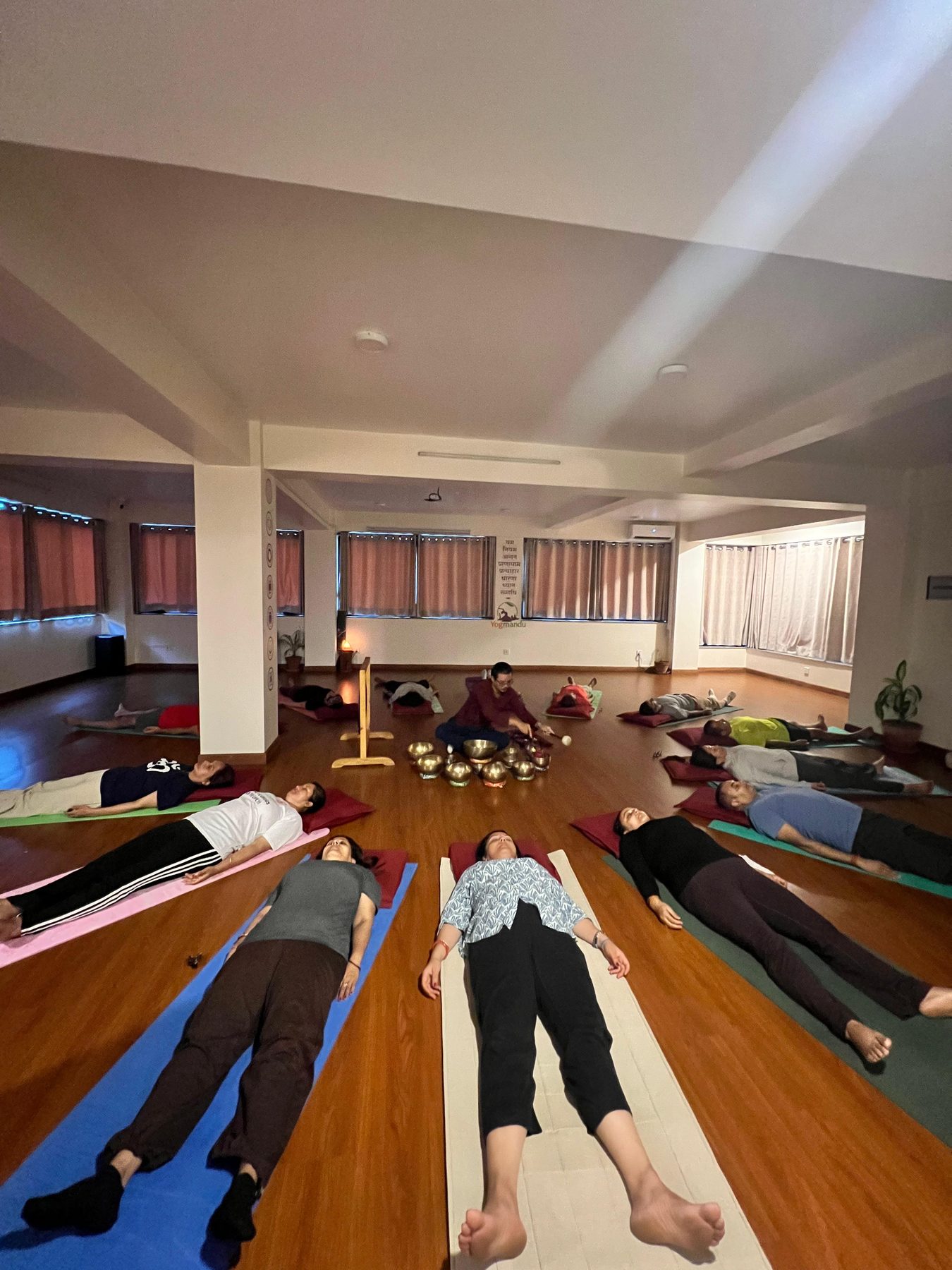
Arjuna seated with a set of Tibetan singing bowls during a sound healing session in Kathmandu
Bowls · Before a session
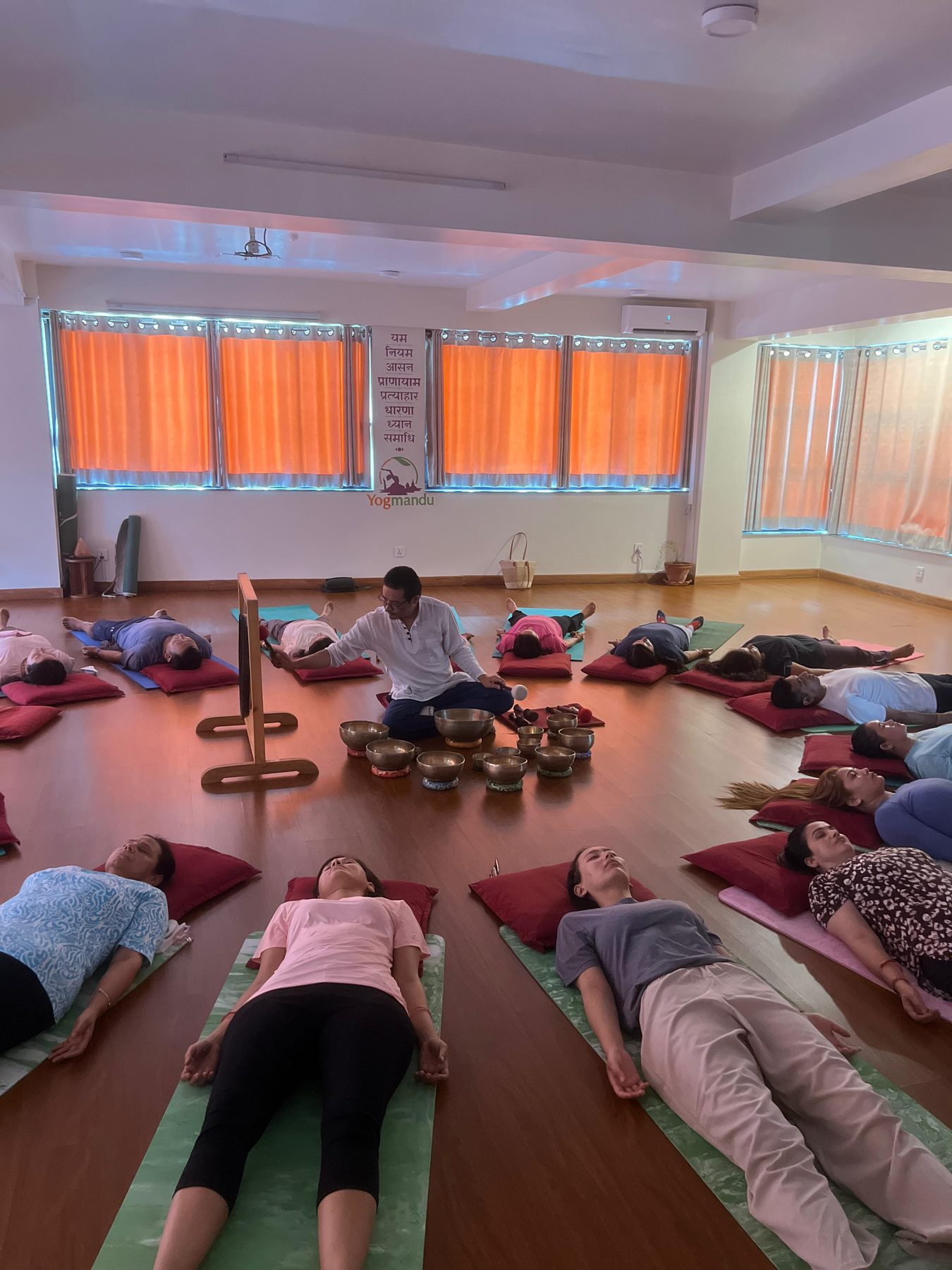
Teacher striking a singing bowl beside a gong during a sound healing session at Yogmandu, Kathmandu
Gong · Mid-session
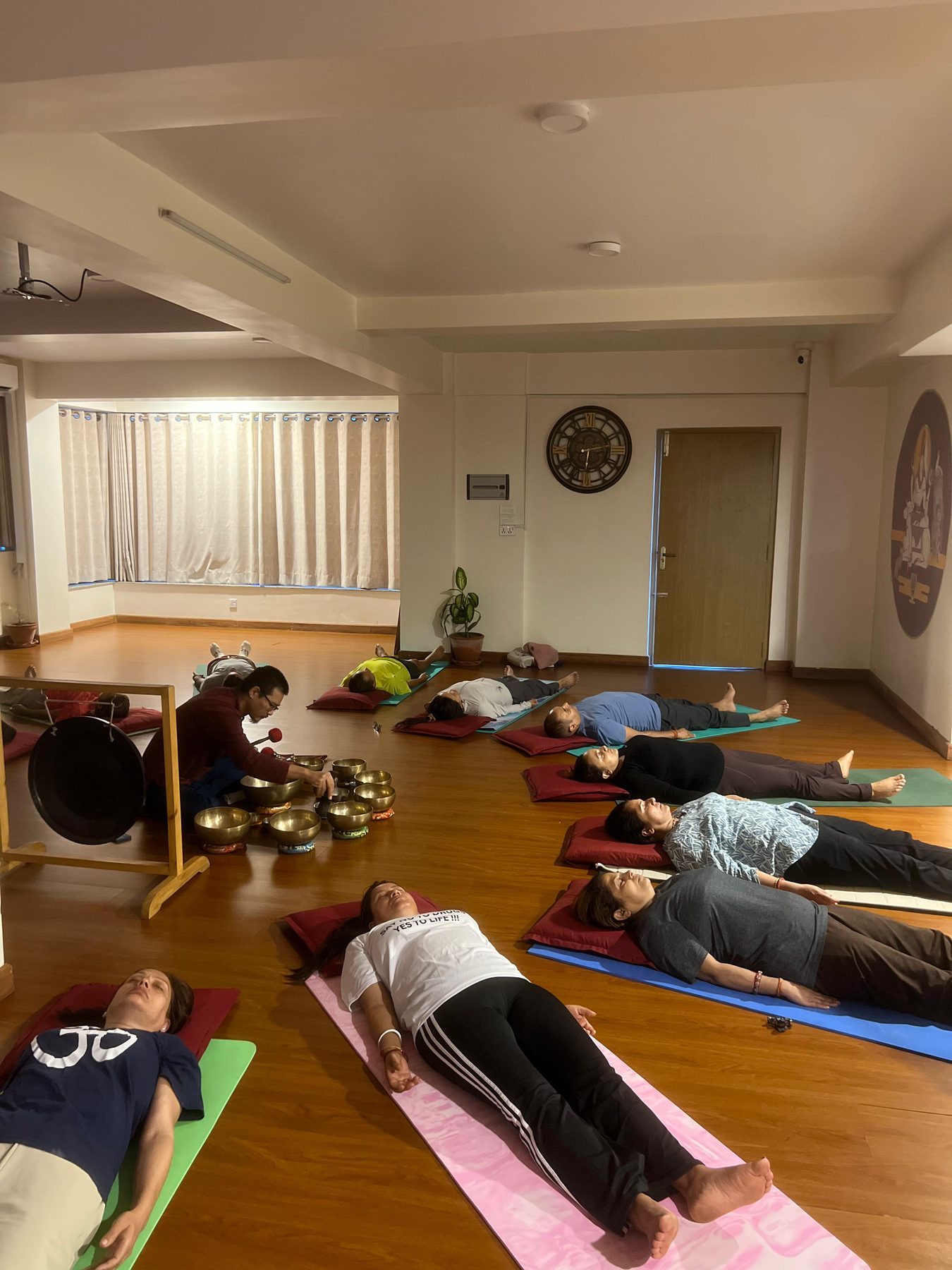
Students resting in savasana on bolsters around a set of singing bowls, Kathmandu
Savasana · Group sound bath

Book an hour of doing nothing

Tell us which therapy you would like, or what you are dealing with, and we will match you to one.

Book a session